From our experience at MQS, the key moment in every project is the transition from business vision to working software. We observe that companies often lose time and money when their processes—even those perfectly designed on paper—do not find a precise reflection in the code. By focusing on business logic, and not just technology, we ensure that every line of code directly supports your financial and operational goals.
Why do processes not translate into profit?
Working with clients, we notice that the main source of problems is the discrepancy between business understanding and its technical implementation. Too often, business analysts and developers operate in worlds isolated from one another. Business presents the "what" (e.g., faster customer service, automated invoicing), and technology delivers the "how". When a strong bridge is missing, the result is software that is technically correct but business-wise useless or requires constant, costly corrections.
The consequences are immediate and measurable: wasted time on unnecessary functionalities that will never be used; wasted money on refactoring code that is not scalable for future needs; and finally—loss of competitive advantage because the deployment of a key feature is delayed by months. The numbers show this clearly: a project that needs to be changed by 50% after the first deployment generates enormous hidden costs and team demotivation.
Critical gaps in the standard approach
We believe that the traditional approach, consisting of rushing from requirements to coding, is fraught with high risk. Critical stages, which we at MQS consider the foundation of effective development, are usually skipped.
First, there is a lack of formal mapping of processes to the domain model. A business process, e.g., "order processing," consists of many steps, rules, and exceptions. Without precisely translating them into objects, methods, and services in the code, developers improvise, which leads to spaghetti code and dependencies that prevent the system's evolution.
Second, there is insufficient focus on Bounded Contexts. When the entire system is treated as one monolithic whole, a change in one process (e.g., pricing) affects seemingly unrelated processes (e.g., shipping), which drastically increases the risk of error and deployment time. This approach generates technical debt from day one.
The MQS Way: Profit through Process-Oriented Architecture
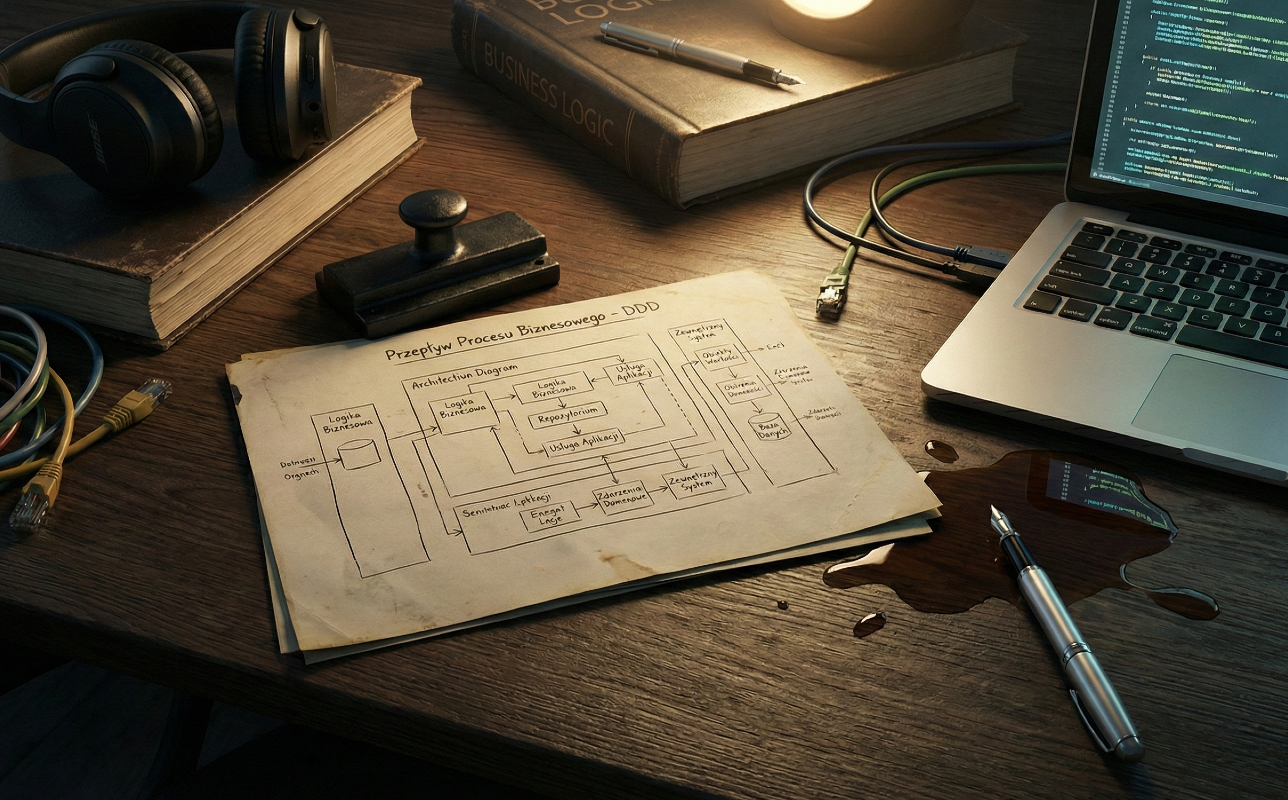
At MQS, our process is built so that business logic is always at the center of the code. We do not treat architecture as art for art’s sake, but as a tool to maximize value for the client. The key is Domain-Driven Design (DDD) and precise modeling of business logic using modern tools, which we call Process-Oriented Architecture (POA).
1. Ubiquitous Language and Domain Model. At the very beginning, we create a shared dictionary. This is a language used by both the business (You) and the technical team (Us). In this way, communication errors and ambiguities are eliminated. The domain model becomes the single source of truth. Our experience shows that this step shortens integration time by at least 20%, because everyone knows what they are talking about.
2. Mapping processes to Bounded Contexts. We believe that an IT system should reflect the organization of your business. Therefore, we divide the entire system into autonomous parts, each focusing on one key business process. Such architecture means that a change in the Product Management area does not require re-testing the entire system. As a result: you increase your market flexibility.
3. Aggregates and business rules in code. In POA, business rules are enclosed within Aggregates—clusters of objects that are always transactionally consistent. If a rule states that "An Order must have a Pending status before Sent," this rule is enforced by the code and is impossible to bypass. Thanks to this, we achieve nearly 100% certainty that the code works exactly as the business requires.
Final Conclusions: Investment in architecture is profit
Our experience shows that for clients, the investment in precisely translating business processes into software architecture pays off many times over. Not only by avoiding costly corrections but primarily through the speed of delivering new business value.
At MQS, we believe that a well-designed system is one where change is cheap and safe. Using POA and DDD, we deliver software that is ready for evolution and scaling, which is crucial for companies aiming for digital dominance. We do not write code for code's sake. We create digital assets that generate concrete, measurable profit for you.